Plan-based Diet and Uprooting the Leading Causes of Death - by Michael Greger, M.D. (video), a lecture and Q&A session at Tompkins County Public Library, Ithaca, NY:
Monday, January 23, 2017

Tuesday, January 17, 2017
Patient-centered communication: what are the basic skills?
Communication skills needed for patient-centered care include:
- eliciting the patient's agenda with open-ended questions, especially early on
- not interrupting the patient
- engaging in focused active listening
Practice this at least in the first 60-seconds, the so-called "golden minute".
Understand patient's perspective
Understanding the patient's perspective of the illness and expressing empathy are key features of patient-centered communication.
Understanding the patient's perspective entails exploring the patient's:
- feelings
- ideas
- concerns
- experience regarding the impact of the illness
- expectations from the physician
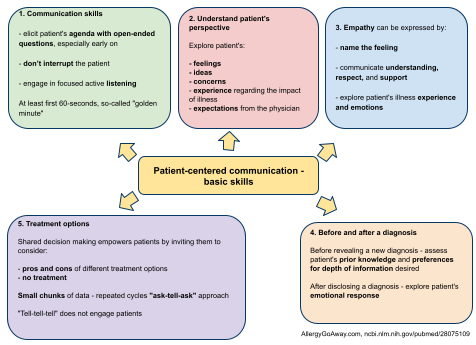
Patient-centered communication - basic skills (click here to enlarge the image).
Empathy
Empathy can be expressed by:
- naming the feeling
- communicating understanding, respect, and support
- exploring the patient's illness experience and emotions
Before and after a diagnosis
Before revealing a new diagnosis, the patient's prior knowledge and preferences for the depth of information desired should be assessed.
After disclosing a diagnosis, physicians should explore the patient's emotional response.
Treatment options
Shared decision making empowers patients by inviting them to consider:
- pros and cons of different treatment options
- no treatment
Instead of overwhelming the patient with medical information, small chunks of data should be provided using repeated cycles of the "ask-tell-ask" approach. Using "tell-tell-tell" does not engage patients.
Example:
1. Ask permission to start a conversation
3. Ask what the patient thinks about their health
4. Ask questions to find out what the patient already knows
5. Tell the patient information in a way that is easy to understand
6. Gauge the patient’s understanding by asking questions after you tell
What Is “Ask, Tell, Ask”? video:
References:
Patient-Centered Communication: Basic Skills. Hashim MJ. Am Fam Physician. 2017 Jan 1;95(1):29-34.
https://www.ncbi.nlm.nih.gov/pubmed/28075109
The 10 Building Blocks of Primary Care - “Ask Tell Ask” Sample Curriculum - UCSF
Ask-Tell-Ask: Simple Technique Can Help Hospitalists Communicate Difficult Messages http://buff.ly/2jeNVIN
- eliciting the patient's agenda with open-ended questions, especially early on
- not interrupting the patient
- engaging in focused active listening
Practice this at least in the first 60-seconds, the so-called "golden minute".
Understand patient's perspective
Understanding the patient's perspective of the illness and expressing empathy are key features of patient-centered communication.
Understanding the patient's perspective entails exploring the patient's:
- feelings
- ideas
- concerns
- experience regarding the impact of the illness
- expectations from the physician
Patient-centered communication - basic skills (click here to enlarge the image).
Empathy
Empathy can be expressed by:
- naming the feeling
- communicating understanding, respect, and support
- exploring the patient's illness experience and emotions
Before and after a diagnosis
Before revealing a new diagnosis, the patient's prior knowledge and preferences for the depth of information desired should be assessed.
After disclosing a diagnosis, physicians should explore the patient's emotional response.
Treatment options
Shared decision making empowers patients by inviting them to consider:
- pros and cons of different treatment options
- no treatment
Instead of overwhelming the patient with medical information, small chunks of data should be provided using repeated cycles of the "ask-tell-ask" approach. Using "tell-tell-tell" does not engage patients.
Example:
1. Ask permission to start a conversation
3. Ask what the patient thinks about their health
4. Ask questions to find out what the patient already knows
5. Tell the patient information in a way that is easy to understand
6. Gauge the patient’s understanding by asking questions after you tell
What Is “Ask, Tell, Ask”? video:
References:
Patient-Centered Communication: Basic Skills. Hashim MJ. Am Fam Physician. 2017 Jan 1;95(1):29-34.
https://www.ncbi.nlm.nih.gov/pubmed/28075109
The 10 Building Blocks of Primary Care - “Ask Tell Ask” Sample Curriculum - UCSF
Ask-Tell-Ask: Simple Technique Can Help Hospitalists Communicate Difficult Messages http://buff.ly/2jeNVIN
Monday, January 16, 2017
Percentage of U.S. residents with up-to-date screening for colorectal cancer remains at 60% - what options, other than colonoscopy, do we have?
From the NEJM:
The percentage of U.S. residents with up-to-date screening for colorectal cancer has not increased appreciably since 2010 and remains at approximately 60%. To achieve the highest level of adherence to colorectal cancer screening, it may be best to provide participants a choice, because the “best” strategy is the one that they will adhere to consistently.
The NEJM reviews all the options in this table:
http://blogs.nejm.org/now/wp-content/uploads/sites/6/2017/01/nejmcp1512286_t2.jpeg
Full article is here:
Screening for Colorectal Neoplasia - Now@NEJM http://buff.ly/2ikfKA0
The percentage of U.S. residents with up-to-date screening for colorectal cancer has not increased appreciably since 2010 and remains at approximately 60%. To achieve the highest level of adherence to colorectal cancer screening, it may be best to provide participants a choice, because the “best” strategy is the one that they will adhere to consistently.
The NEJM reviews all the options in this table:
http://blogs.nejm.org/now/wp-content/uploads/sites/6/2017/01/nejmcp1512286_t2.jpeg
Full article is here:
Screening for Colorectal Neoplasia - Now@NEJM http://buff.ly/2ikfKA0
Tuesday, January 10, 2017
Physician ratings at Cleveland Clinic (video)
The CEO and the Chief Experience Officer explain the rationale behind the physician ratings at Cleveland Clinic:
Disclaimer: I am an allergist at Cleveland Clinic Florida.
Disclaimer: I am an allergist at Cleveland Clinic Florida.
Friday, January 6, 2017
Problem solver
From Italian: Pedro and Domenico jump, but Oreste thinks about it a bit... and finds another solution.
#donkey #problemsolving
Related:
This little video even made it to Daily Mail: Donkey shows off his brains by using his TEETH to remove a fence http://buff.ly/2iYmpzn
#donkey #problemsolving
Related:
This little video even made it to Daily Mail: Donkey shows off his brains by using his TEETH to remove a fence http://buff.ly/2iYmpzn
Gadgets Galore - Best of CES 2017
From WSJ: As the tech world reveals the products that will impact the year ahead, Personal Tech columnists Geoffrey A. Fowler and Joanna Stern hunt for the most exciting and unusual, from AR glasses to breast pumps (video is below):
http://on.wsj.com/2j9crYt
http://on.wsj.com/2j9crYt
Subscribe to:
Comments (Atom)
-
Dr. Andreas Finner (Trichomed Praxis Berlin) talks about what everyone can do to keep a full head of hair and about the best methods for tre...

